Commissioner Resources
Fantasy Football Salary Cap Leagues: Complete Guide
Fantasy football salary cap leagues make every dollar matter. Learn how salaries, contracts, dead cap, rookie deals and free agency can transform dynasty fantasy football.
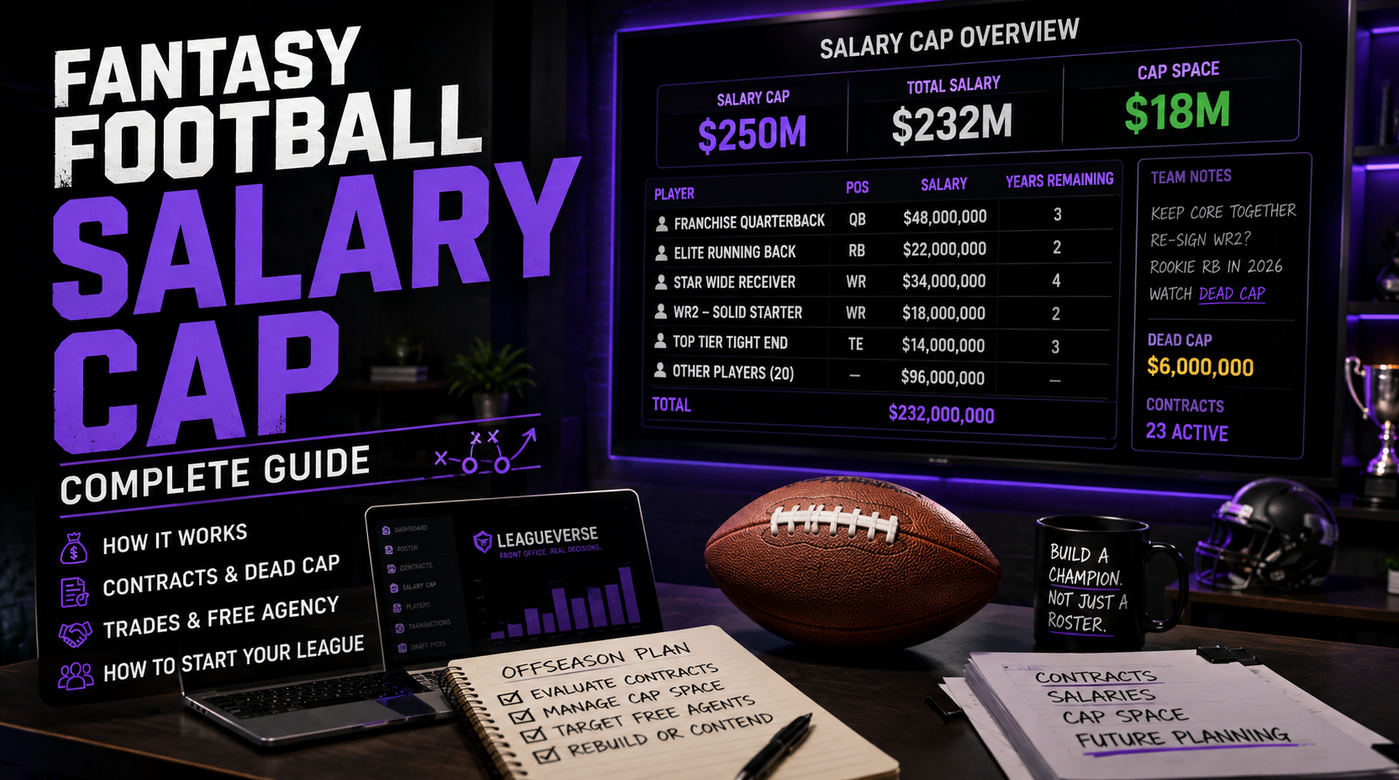
Fantasy Football Salary Cap Leagues: How They Work & How to Start One
Building a stacked fantasy football roster is easy when money doesn't matter.
Want three elite wide receivers, a top-five quarterback and one of the best running backs in football?
Go get them.
A fantasy football salary cap league changes the equation.
Instead of simply trying to acquire the best players, managers have to build the best roster they can afford. Every player has a salary, every franchise has a limited amount of cap space, and spending big money on one superstar means having less money available everywhere else.
Add multi-year contracts, rookie deals, free agency and dead cap, and fantasy football starts looking a lot more like running an actual NFL front office.
Here's how fantasy football salary caps work, how to set up a salary cap league, and why the format can take dynasty fantasy football to another level.
What Is a Fantasy Football Salary Cap?
A fantasy football salary cap is a limit on the total amount of player salary a fantasy team can carry.
For example, imagine every franchise in your league receives a:
$250 million salary cap
One team's roster might look like this:
Player
Position
Salary
Franchise QB
QB
$48M
Star RB
RB
$22M
Elite WR
WR
$34M
WR2
WR
$18M
Starting TE
TE
$14M
Other Players
—
$94M
Total Salary
$230M
That team would have:
$250M Salary Cap − $230M Player Salaries = $20M Cap Space
The manager can use that remaining $20 million to sign players, make trades or otherwise improve the roster depending on the league's rules.
The challenge is simple:
Build the best possible fantasy football team without exceeding your salary cap.
How Does a Fantasy Football Salary Cap League Work?
Every salary cap league can operate differently, but the basic concept is usually the same.
Each franchise receives the same spending limit.
Players are assigned salaries through a startup auction, free agency, predetermined values or another system established by the commissioner.
Managers then have to keep their roster under the league's salary cap.
In a basic league, salaries may simply determine how much of the cap each player consumes.
Advanced dynasty leagues can go much further by adding:
- Multi-year contracts
- Guaranteed salary
- Signing bonuses
- Dead cap
- Contract extensions
- Rookie contracts
- Franchise tags
- Restricted free agency
- Unrestricted free agency
- Annual salary increases
Once those elements are introduced, roster construction becomes significantly more strategic.
You're no longer asking:
"Is this player good?"
You're asking:
"Is this player worth his contract?"
That's a completely different question.
Salary Cap Fantasy Football vs. Salary Cap Drafts
This distinction is important.
You may have seen a Salary Cap Draft option on a traditional fantasy football platform.
That's not necessarily the same thing as a salary cap league.
In a traditional salary cap draft, every manager receives a fictional budget — perhaps $200 — and bids on players during the draft.
Once the draft ends, however, that budget may no longer matter.
A true fantasy football salary cap league carries the financial element into roster management.
Player salaries continue to matter.
Cap space matters.
Trades can affect your available cap.
Contracts may expire.
Players can become free agents.
Cutting someone may create penalties.
The salary cap isn't simply a draft mechanic.
It's part of running your franchise.
Why Add a Salary Cap to Dynasty Fantasy Football?
Dynasty already makes fantasy football more strategic by allowing managers to keep their players from year to year.
But traditional dynasty can create one major advantage:
If you acquire an elite player, you may be able to keep him indefinitely without paying any additional cost.
A salary cap changes that.
Imagine you drafted a young wide receiver who eventually becomes one of the best players in football.
In normal dynasty?
Congratulations. He's yours.
In a contract league?
His rookie contract might eventually expire.
Now you have a decision.
Do you give him a massive extension?
Use a franchise tag?
Let him enter free agency?
Trade him before his contract expires?
Suddenly, even the strongest rosters require constant management.
That's one reason salary cap dynasty leagues can create such a deep fantasy football experience.
Fantasy Football Salaries Make Player Value More Complicated
In traditional fantasy football, managers mostly evaluate players based on production and future potential.
Salary cap leagues introduce another variable:
cost.
Consider two fictional wide receivers.
Player A
Projected fantasy points: 285
Salary: $38 million
Player B
Projected fantasy points: 245
Salary: $13 million
Player A may be the better fantasy player.
But is he the better asset?
Maybe.
Maybe not.
Player B produces slightly fewer points while saving $25 million in cap space.
That money could potentially upgrade several other positions.
This creates one of the most important concepts in salary cap fantasy football:
Player Value vs. Contract Value
The best fantasy player isn't always the most valuable player.
A superstar on a massive contract can still be valuable.
But a breakout player making almost nothing?
That can be franchise-changing.
This makes young players and rookie contracts especially interesting.
If your league uses controlled rookie salaries, hitting on a rookie can give you elite fantasy production at a fraction of the cost of an established veteran.
It's essentially fantasy football's version of finding a star on a rookie deal.
How Do Contracts Work in Fantasy Football?
Contracts aren't required for a salary cap league, but they add significantly more depth.
Instead of simply assigning a salary to each player, leagues can determine how long that player remains under team control.
For example:
Player: Fictional WR
Salary: $24 million per year
Contract: 3 years
Total Contract Value: $72 million
The manager now controls that player for three seasons at $24 million annually.
When the contract expires, the player could:
- Become a free agent
- Receive an extension
- Receive a franchise tag
- Enter restricted free agency
- Be released
The exact system depends on your league's rules.
This forces managers to think beyond the current season.
What Is Dead Cap in Fantasy Football?
Here's where things get painful.
Suppose you sign a player to a long-term contract.
Two years later, he's terrible.
You want him gone.
In a basic fantasy league, you click Drop.
Problem solved.
A more advanced salary cap league can impose dead cap for terminating certain contracts early.
Dead cap is salary that continues counting against your team's cap even though the player is no longer on your roster.
For example:
Player salary: $30M
Applicable release penalty: $12M
You release him.
The player disappears.
But that $12 million?
It's still sitting on your books.
Now your terrible contract decision has consequences.
Just like a real front office.
How Do Trades Work in Salary Cap Fantasy Football?
Trades become significantly more interesting when contracts are involved.
Imagine Team A wants an elite running back from Team B.
In a traditional dynasty league, the negotiation might revolve around players and rookie picks.
In a salary cap league, both managers also need to consider:
Can Team A afford the player's contract?
A trade could therefore involve:
Team A receives:
- Star RB
- $26M salary obligation
Team B receives:
- Young WR
- 2027 first-round pick
- 2028 second-round pick
Even if Team A likes the deal from a football perspective, it may need $26 million in available cap space to complete it.
That makes roster management part of trade strategy.
What Happens When a Player's Contract Expires?
This is where a fantasy football contract league can really come alive.
When contracts expire, players can enter an offseason free-agent pool.
Managers then compete to sign them.
Depending on your league, free agency could operate through:
- Auctions
- Blind bidding
- FAAB
- Open bidding periods
- Restricted free agency
- Commissioner-managed negotiations
Imagine one of the best wide receivers in your league hitting free agency.
Suddenly every franchise starts checking its cap space.
One team has $8 million.
Another has $22 million.
The rebuilding team that spent two years clearing bad contracts?
They have $67 million.
Now the offseason itself becomes competitive.
How Should Rookie Contracts Work?
Rookie contracts can be one of the best features of a salary cap dynasty league.
Instead of allowing managers to determine rookie salaries randomly, leagues can establish a rookie wage scale based on draft position.
For example:
1.01: $12M/year
1.02: $11M/year
1.03: $10M/year
...
2.01: $5M/year
The exact numbers aren't important here.
The structure is.
Higher draft picks cost more, while later picks can provide tremendous value if the player develops.
This adds another dimension to rookie draft strategy.
The 1.01 isn't simply the best prospect.
It's also an investment against your salary cap.
What Should a Fantasy Football Salary Cap Be?
There is no universal perfect salary cap.
Your league could use:
$100 million
$200 million
$250 million
Or even fictional values such as:
$500
What matters isn't the number itself.
What matters is how player salaries relate to that number.
A $250 million cap works perfectly well if salaries are designed around a $250 million economy.
A $500 cap works perfectly well if salaries are designed around $500.
The goal should be creating enough scarcity that managers are forced to make difficult decisions.
If every team can afford every player it wants, the salary cap isn't accomplishing much.
Should the Salary Cap Increase Every Year?
It can.
Some leagues keep the salary cap fixed for simplicity.
Others increase it annually to simulate the NFL's changing salary cap.
For example:
2026: $250M
2027: $260M
2028: $270M
You could use a fixed annual percentage or allow the commissioner to establish future caps.
Increasing the cap creates another strategic consideration when managers negotiate long-term contracts.
A $30 million salary might feel expensive today.
Three years from now?
Maybe not.
How to Start a Fantasy Football Salary Cap League
If you're creating one from scratch, don't add every possible rule immediately.
Start with a strong foundation.
Step 1: Determine the Salary Cap
Choose the total spending limit available to each franchise.
Step 2: Determine How Players Receive Salaries
You could use a startup auction, predetermined salary values or another bidding system.
Step 3: Determine Contract Length
Decide whether contracts exist and, if so, the maximum number of years managers can offer.
Step 4: Establish Release Penalties
Determine whether cutting a player creates dead cap and how that penalty is calculated.
Step 5: Create Rookie Contracts
Establish how rookie salaries and contract lengths are determined.
Step 6: Create a Free Agency System
Determine what happens when contracts expire and how teams bid on available players.
Step 7: Establish Trade Rules
Decide how salaries, contracts and available cap space affect trades.
Step 8: Put Everything in Writing
This is critical.
Your league constitution should clearly explain every salary and contract rule before the startup draft.
Don't wait until someone wants to cut a terrible $40 million contract to decide how dead cap works.
Example Salary Cap Dynasty League Setup
If you're looking for a starting point, a league might use something like:
Setting
Example
Teams
12
Salary Cap
$250M
Starting Lineup
10
Total Roster
25
Contract Length
1–5 years
Rookie Contracts
3–4 years
Annual Cap Increase
3–5%
Franchise Tags
1 per team
Free Agency
Offseason bidding
Dead Cap
Based on remaining guarantees
Future Pick Trading
3 years
These aren't rules every league needs to copy.
They're simply an example of how a salary cap dynasty league could be structured.
The best setup is the one your league understands, enjoys and can manage consistently.
Are Salary Cap Fantasy Football Leagues Hard to Manage?
They can be.
That's the downside.
A normal fantasy platform can easily track:
Scores.
Rosters.
Standings.
Waivers.
Matchups.
But once your league introduces contracts, salaries, future contract years, dead cap, franchise tags and free agency, commissioners often end up managing an entirely separate system.
That can mean spreadsheets.
Lots of spreadsheets.
One sheet for contracts.
Another for salaries.
Another for future years.
Another for dead cap.
Then someone makes a trade at 11:47 PM and the commissioner has to update everything manually.
That's exactly the problem LeagueVerse is designed to solve.
Manage Your Fantasy Football Salary Cap With LeagueVerse
LeagueVerse turns dynasty fantasy football into a true front-office experience.
Instead of replacing the fantasy platform your league already uses, LeagueVerse can become the management layer around it.
Your fantasy platform handles the football.
LeagueVerse handles the franchise.
Track things like:
- Player contracts
- Contract years
- Salaries
- Team salary caps
- Cap space
- Transactions
- Future roster commitments
- Draft capital
- Commissioner approvals
- League history
For leagues using compatible integrations, roster activity can flow into the broader LeagueVerse management experience instead of forcing commissioners to recreate every move manually.
The result is a dynasty league where managers aren't simply setting lineups.
They're building franchises.
Because assembling a superteam is easy when money doesn't matter.
Building a championship roster under the cap is where things get interesting.
Take Dynasty Further
Run Your League Like a Front Office.
LeagueVerse adds contracts, salary caps, franchise tags, free agency, rookie contracts, and complete offseason management to your existing fantasy league.
See How LeagueVerse Works