Commissioner Resources
Dynasty Fantasy Football Rules: Complete 2026 Guide
Starting a dynasty league? These dynasty fantasy football rules cover rosters, rookie drafts, trades, taxi squads, tanking, future picks and commissioner powers.
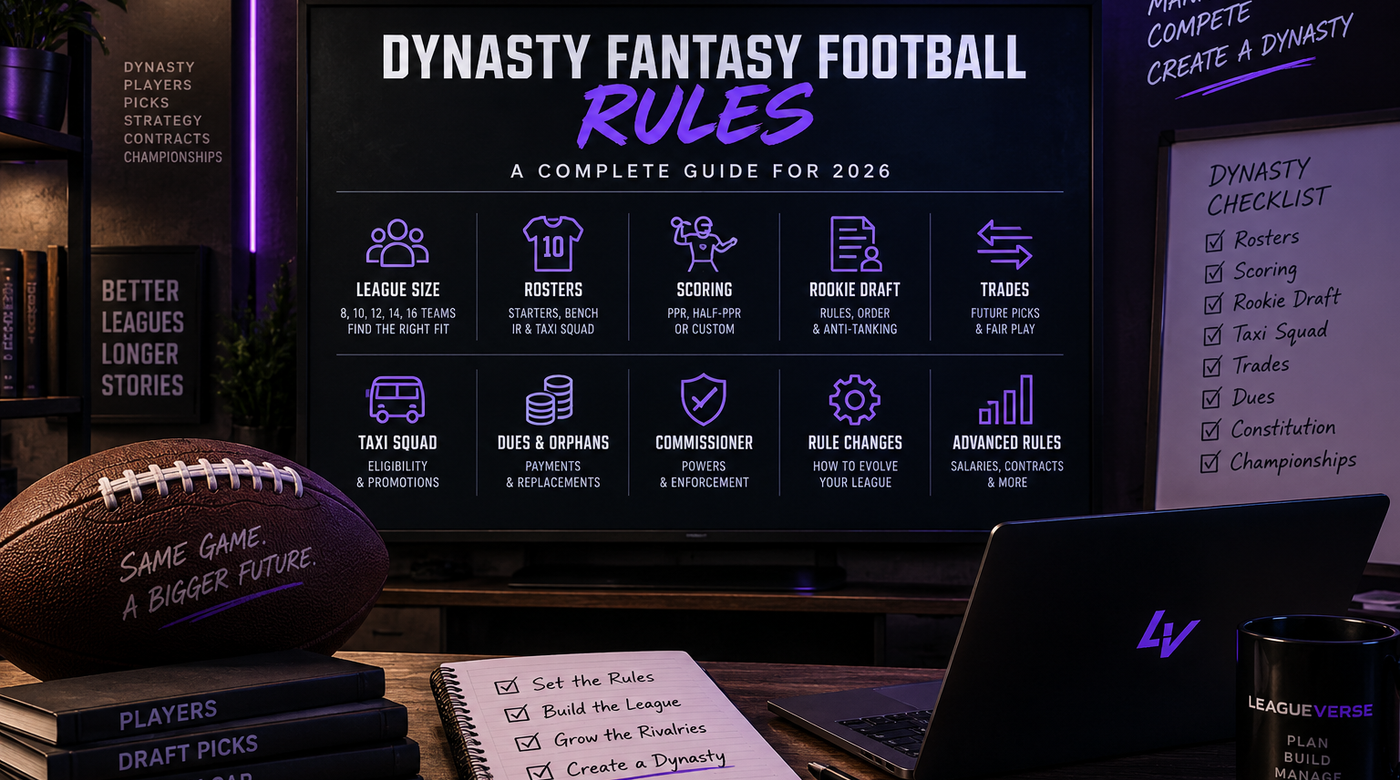
Dynasty Fantasy Football Rules: Complete Guide for 2026
Starting a dynasty fantasy football league is easy.
Keeping one running for the next 10 years without your group chat turning into a courtroom is harder.
That's why every serious dynasty league needs clearly defined dynasty fantasy football rules before the startup draft begins.
Who gets the first rookie pick?
Can managers intentionally tank?
Can you trade a 2029 first-round pick?
What happens if someone trades all their picks and quits?
Can the commissioner veto a terrible trade?
Who is eligible for the taxi squad?
What happens when the league wants to change a rule?
Those questions might seem unimportant when everyone is excited about the startup draft.
They won't seem unimportant when two managers are screaming at each other three years later.
This guide covers the dynasty fantasy football rules every commissioner should establish, along with recommended settings you can use as a starting point for your own league.
What Are Dynasty Fantasy Football Rules?
Dynasty fantasy football rules establish how your league operates from one season to the next.
Unlike a traditional redraft league, a dynasty league doesn't reset every year. Managers retain most or all of their rosters, trade future draft picks and participate in annual rookie drafts.
That makes seemingly small decisions much more important.
If you're brand new to the format, start with our guide explaining what a dynasty fantasy football league is before building your rulebook.
Your league's complete set of rules is often called its league constitution or bylaws.
And yes, you should actually have one.
"That's how we've always done it" is not a rulebook.
1. Establish Your League Size
First, decide how many franchises your dynasty league will have.
Common options include:
- 8 teams
- 10 teams
- 12 teams
- 14 teams
- 16 teams
For most leagues, 10 or 12 teams provides a good balance.
League size affects virtually everything else.
A 16-team league creates dramatically more player scarcity than an 8-team league, so roster sizes, starting requirements and quarterback settings should be designed accordingly.
Whatever you choose, establish the number before determining the rest of your settings.
2. Set Starting Lineups and Roster Size
Dynasty rosters should generally be deeper than traditional redraft rosters.
The entire point is being able to develop players over multiple seasons.
A sample 12-team dynasty league could use:
Position
Starters
QB
1
RB
2
WR
3
TE
1
FLEX
2
SUPERFLEX
1
Total
10
Then give each franchise another 12–18 bench spots, plus optional injured reserve and taxi-squad positions.
There's no universal perfect roster size. Existing dynasty leagues vary considerably, with examples ranging from roughly 20 active players to 25+ total active/bench players before IR or taxi spots.
The important thing is creating enough scarcity that managers can't simply replace every injured or underperforming player from waivers.
Dynasty should reward roster construction.
3. Decide Between 1QB and Superflex
This needs to be decided before the startup draft.
1QB
Each franchise starts one quarterback.
Quarterbacks generally become less valuable because only 10–12 need to start each week.
Superflex
Teams have an additional FLEX position that can include a quarterback.
Because quarterbacks generally outscore other positions, most managers use a second QB there.
That dramatically increases quarterback value.
A young franchise quarterback can become one of the most valuable assets in a Superflex dynasty league.
Neither format is inherently correct.
But switching from 1QB to Superflex after your league has already drafted can completely reshape player values, so this is the type of foundational rule that should be settled before Year 1.
4. Establish Your Scoring Rules
Next, determine how fantasy points are awarded.
Common formats include:
Standard: No points per reception.
Half-PPR: 0.5 points per reception.
PPR: 1 point per reception.
Advanced leagues may add:
- Tight end premium
- Points per first down
- Bonuses for long touchdowns
- Yardage bonuses
- Customized quarterback scoring
- IDP scoring
The important thing isn't choosing the "perfect" system.
It's publishing the scoring rules before the startup draft.
Managers will value players differently based on your scoring.
5. Create Annual Rookie Draft Rules
The annual rookie draft is one of the defining features of dynasty fantasy football.
After the startup year, managers draft incoming NFL rookies each offseason.
Your rules should specify:
- Number of rounds
- Rookie eligibility
- Draft date
- Draft order
- Pick timer
- Whether picks can be traded
- What happens if a manager misses a pick
Most importantly:
Rookie drafts should generally be linear, not snake.
If the team with the 1.01 also receives the 2.01 and 3.01, weaker teams receive a meaningful opportunity to rebuild rather than immediately giving the advantage back at the second-round turn. Established dynasty rulebooks commonly use straight/linear annual rookie drafts rather than serpentine formats.
6. Determine Rookie Draft Order — and Prevent Tanking
This rule can save your league a massive headache.
Simply awarding the first pick to the team with the worst win-loss record creates an obvious problem:
What stops someone from intentionally benching their best players?
One popular solution is Max Points For (Max PF) for non-playoff teams.
Instead of measuring the points a manager actually started, Max PF measures the points their roster could have produced using an optimal lineup.
For example:
Team A actual points: 1,250
Team A Max PF: 1,610
Team B actual points: 1,400
Team B Max PF: 1,480
Team B's roster was actually weaker even though Team A intentionally or accidentally scored fewer points.
Under a lowest-Max-PF system, Team B would receive the earlier rookie selection.
This approach is used by a number of dynasty leagues specifically to reduce the incentive to manipulate starting lineups.
A clean system could be:
Non-playoff teams: Lowest Max PF → highest rookie pick.
Playoff teams: Draft position based on playoff finish.
Your league should still require managers to set legitimate starting lineups. Max PF shouldn't become permission to start injured players because "it doesn't matter."
7. Establish Future Draft Pick Trading Rules
Trading rookie picks is one of the best parts of dynasty.
Managers should know exactly how far into the future they're allowed to trade.
A league might allow trading picks three seasons ahead.
For example:
During 2026, managers could trade:
2027 picks
2028 picks
2029 picks
But there's a problem.
Imagine someone trades:
2027 first
2028 first
2029 first
...for aging veterans.
Their team collapses.
Then they quit.
Congratulations, commissioner. You now have to convince someone to take over a terrible orphan team with no first-round picks for three years.
Require payment for seasons involving traded future picks.
If a manager trades their 2028 first-round pick, requiring them to pay their 2028 league dues before processing the trade protects the league and makes an abandoned franchise easier to replace.
Real dynasty constitutions use this exact type of future-dues requirement to protect league continuity.
8. Create Clear Dynasty Trade Rules
Dynasty trades can look insane.
That doesn't mean they're unfair.
A contender might trade two first-round picks for an aging superstar.
A rebuilding manager might trade one of their best players for prospects.
One manager may value a rookie completely differently from another.
That's dynasty.
For that reason, league votes should generally not determine whether someone made a "good" trade.
A strong rule is:
Trades stand unless there is evidence of collusion, roster dumping or another violation of league rules.
The commissioner shouldn't become the league's trade-value police. Commissioner guidance and established dynasty rulebooks commonly distinguish collusion from merely lopsided trades.
If someone makes a terrible trade?
They made a terrible trade.
They'll probably hear about it for the next seven years.
That's punishment enough.
9. Define Taxi Squad Rules
Taxi squads allow dynasty managers to stash developmental players outside their normal active roster.
But commissioners need to define exactly how they work.
Your constitution should answer:
How many taxi spots are available?
Who is eligible?
Rookies only?
First- and second-year players?
First three seasons?
When does the taxi squad lock?
Can players return after being promoted?
Can taxi players be traded?
Existing dynasty leagues vary considerably here: some restrict taxi squads to rookies, while others permit players through their second or third NFL seasons. Promotion is also commonly one-way once the season begins.
A simple setup might be:
Taxi spots: 4
Eligibility: Rookies and second-year players
Promotion: Anytime
Demotion: Not permitted after the regular season begins
That gives managers room to develop prospects without making the rules overly complicated.
10. Establish Waiver and Free Agency Rules
Your constitution should also explain how unrostered players are acquired.
FAAB — Free Agent Acquisition Budget — works particularly well for dynasty because every manager receives the same opportunity to bid.
For example:
Annual FAAB budget: $100
Manager A bids $17.
Manager B bids $12.
Manager A gets the player for $17.
You should also establish:
- When waivers process
- Whether FAAB carries over
- Whether $0 bids are allowed
- Offseason waiver rules
- What happens during rookie drafts
Don't wait until a backup running back suddenly becomes a starter at 11 PM to figure this out.
11. Establish Rules for League Dues and Orphan Teams
Dynasty leagues require more commitment than redraft.
Managers aren't signing up for one season.
They're taking control of a franchise that could exist for years.
Your constitution should establish:
- Annual dues
- Payment deadline
- Prize distribution
- Future-year payments
- Refund policy
- What happens when a manager leaves
- How replacement managers are selected
- Whether orphan owners receive discounted/free entry
The commissioner should also have a plan for transferring an abandoned roster without altering the league competitively.
This isn't exciting.
Neither is chasing someone for $100 every August.
Write the rule.
12. Define Commissioner Powers
A dynasty commissioner needs enough authority to keep the league operating.
But nobody wants to play in a dictatorship run by some guy named Brian who thinks being commissioner makes him Roger Goodell.
Your constitution should define what the commissioner can do without a league vote.
Examples might include:
Commissioner can:
- Correct obvious scoring/settings errors
- Reverse accidental transactions
- Enforce existing rules
- Replace inactive managers
- Resolve issues explicitly covered by the constitution
Major structural changes should generally require league approval.
Examples:
- Changing scoring
- Adding Superflex
- Changing roster size
- Changing rookie draft rules
- Adding salaries/contracts
- Changing playoff structure
The commissioner administers the league.
They don't own it.
13. Establish a Rule-Change Process
Your league will evolve.
That's normal.
Maybe managers want another FLEX.
Maybe everyone hates kickers.
Maybe you want to add a taxi squad.
Maybe the league wants to transition into salaries and contracts.
Create a process before those arguments happen.
For example:
Minor rule change: Simple majority
Major structural change: Two-thirds majority
Immediate in-season change: Unanimous approval
Normal approved changes: Effective the following season
Some long-running dynasty constitutions explicitly delay approved changes until a future league year unless unanimous consent supports immediate implementation.
That's a smart principle because managers built their rosters under the existing rules.
Don't suddenly change the value of their assets halfway through a season.
14. Define Inactivity and Lineup Rules
What happens if a manager stops setting their lineup?
You need an answer.
Require every manager to field a reasonable active lineup each week.
Repeated violations could result in:
First offense: Warning
Second offense: Commissioner intervention
Repeated offenses: Draft-pick penalty or replacement
Be careful with punishment systems.
The objective isn't to micromanage managers.
It's to protect competitive integrity for everyone else.
15. Create Rules for Collusion
This one's simple.
Don't do it.
Collusion occurs when managers cooperate in a way that undermines legitimate competition.
Examples could include:
- Temporarily "loaning" players
- Coordinating roster moves to manipulate another team's result
- Trading assets with an agreement to return them later
- Giving another team players without legitimate competitive consideration
This is fundamentally different from making a trade someone else thinks is stupid.
Bad trade ≠ collusion.
Your constitution should make that distinction clear.
Recommended Dynasty Fantasy Football League Settings
If you're starting a league and want a baseline, here's a LeagueVerse-style setup I'd consider:
Setting
Recommendation
Teams
12
Format
Superflex
Scoring
PPR
QB
1
RB
2
WR
3
TE
1
FLEX
2
SUPERFLEX
1
Bench
15
IR
3
Taxi
4
Rookie Draft
4 rounds
Rookie Draft Type
Linear
Non-Playoff Draft Order
Lowest Max PF
Waivers
FAAB
Future Pick Trading
3 years
Trade Voting
None
Trade Intervention
Collusion/rule violations only
Future Pick Dues
Pay corresponding future season
Rule Changes
League vote
This isn't the only way to play dynasty.
That's the point.
Your league should create rules that fit the experience your managers want.
Advanced Dynasty Rules: Salaries and Contracts
Once your league has mastered traditional dynasty, there's another level.
Salary cap dynasty.
Instead of controlling players indefinitely, managers have to operate within a salary cap.
You can introduce:
- Player salaries
- Multi-year contracts
- Rookie contracts
- Contract extensions
- Dead cap
- Franchise tags
- Free agency
- Salary-cap increases
Now acquiring a superstar is only half the equation.
You also have to afford him.
A $35 million wide receiver might be incredible.
A breakout receiver making $6 million might be an even better asset.
We've put together a full guide explaining how fantasy football salary cap leagues work, because this format fundamentally changes roster construction.
And this is where dynasty starts feeling less like managing a fantasy roster and more like running an actual front office.
Sample Dynasty League Constitution
You don't need a 40-page legal document.
But you should have something.
At minimum, your dynasty league constitution should contain these sections:
1. League Structure
Teams, platform and league format.
2. Rosters
Starting requirements, bench, IR and taxi squad.
3. Scoring
Complete scoring settings.
4. Startup Draft
Format, order and trading rules.
5. Rookie Draft
Eligibility, rounds and draft-order determination.
6. Trades
Deadlines, future picks and commissioner intervention.
7. Waivers
FAAB and free agency procedures.
8. Tanking & Competitive Integrity
Lineup requirements and rookie draft rules.
9. League Dues
Payment deadlines and future-pick requirements.
10. Orphan Teams
Replacement-owner procedures.
11. Commissioner Authority
What the commissioner can and cannot do.
12. Rule Changes
Voting thresholds and implementation dates.
Put it somewhere every manager can access.
Then make every owner agree to it before the startup draft.
You will save yourself countless headaches later.
The Best Dynasty Rules Make the Commissioner Less Important
That's really the goal.
A well-run dynasty league shouldn't require the commissioner to make judgment calls every week.
The rules already tell everyone what happens.
Trade dispute?
Check the constitution.
Rookie draft question?
Check the constitution.
Taxi eligibility?
Check the constitution.
Manager quits?
Check the constitution.
The best commissioners don't control everything.
They build a system that doesn't require them to.
Take Your Dynasty League Beyond the Rulebook
Once your dynasty league becomes more sophisticated, managing everything can become a job of its own.
Rosters.
Draft picks.
Transactions.
Contracts.
Salaries.
Cap space.
League history.
Commissioner approvals.
And somewhere along the way, somebody creates a Google Sheet with 14 tabs that only one person understands.
That's the problem LeagueVerse is built to solve.
LeagueVerse adds a true front-office management layer to dynasty fantasy football, giving commissioners and managers a home for the parts of dynasty that traditional fantasy platforms weren't designed to manage.
Use your fantasy platform for the games.
Use LeagueVerse to manage the franchise.
Build your roster. Manage your future. Create a dynasty. Sign up today, it’s only $19 for the full season.
Take Dynasty Further
Run Your League Like a Front Office.
LeagueVerse adds contracts, salary caps, franchise tags, free agency, rookie contracts, and complete offseason management to your existing fantasy league.
See How LeagueVerse Works